
How to Write a Research Paper Introduction: Structure and Examples (CARS Model)


The introduction of a research paper establishes the context for the study, identifies the research gap, and presents the research question or objectives that the study will address. It is the first substantive section the reader encounters after the abstract, and its purpose is to convince the reader that the study is necessary, well-positioned within the existing literature, and clearly focused. A strong introduction takes the reader on a logical path from broad context to specific purpose in a way that makes the research question feel inevitable. [1]
The most widely used framework for structuring research introductions is the CARS (Create a Research Space) model developed by John Swales in 1990, which identifies three rhetorical moves that characterize effective introductions across disciplines. With inadequate problem statements and weak literature framing ranking among the most common reasons for manuscript rejection, the introduction plays a critical role in whether a manuscript survives editorial screening and peer review. An introduction that fails to establish the importance of the topic, does not identify a clear gap, or does not state the research purpose explicitly gives editors a reason to reject before they reach the methods section. This guide explains how the CARS model works, walks through the introduction writing process step by step, provides examples across disciplines, and includes a template and checklist for structuring your own introduction. [1] [2]
Key Takeaways
_(1).jpg)
- The introduction establishes context, identifies the gap, and states the research purpose in a logical sequence
- The CARS model (Swales, 1990) provides the standard three-move structure: establishing territory, establishing a niche, and occupying the niche
- The introduction is not a literature review; it uses literature selectively to build the case for the study
- Each move should flow into the next, creating a narrative that makes the research question feel like a necessary response to the gap
- Common mistakes include providing excessive background, failing to state the gap, and including methods or results
What Is a Research Paper Introduction?
The introduction is the opening section of a research paper that frames the study for the reader. Its function is to explain what the study is about, why it matters, and what specific question or hypothesis it investigates. Unlike the abstract (which summarizes the entire paper including results), the introduction focuses on everything that comes before the study itself: the context, the existing evidence, the gap, and the purpose. [4]
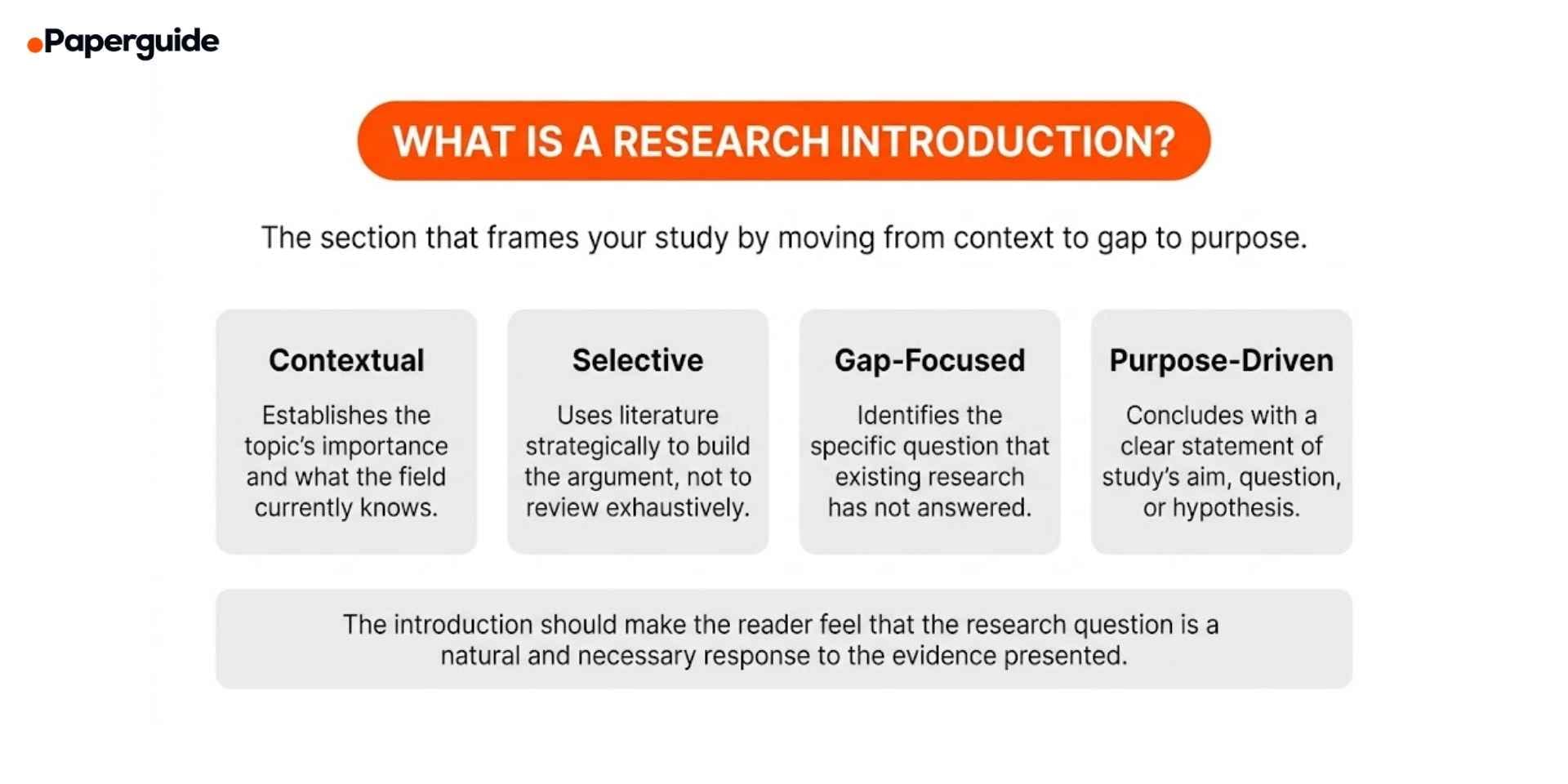
A research introduction is not a comprehensive literature review. It draws on existing literature selectively to establish context and build the argument for the study. In a journal article, the introduction is typically 500 to 1000 words (roughly 10 to 15 percent of the total manuscript). In a thesis, the introduction chapter may be longer, sometimes incorporating the background and literature review as subsections. Regardless of length, the rhetorical structure follows the same pattern: from what is known, to what is not known, to what this study will do about it. [1] [2]
Researchers preparing their introductions often find that having already written a research paper abstract helps clarify the core argument, because the abstract forces a compressed version of the same logic the introduction develops at greater length.
The CARS Model (3 Moves)
John Swales developed the CARS model by analyzing hundreds of published research article introductions across disciplines. He identified a recurring three-move structure that characterizes effective introductions. [1]
| Move | Purpose | Typical Content | Common Signals |
|---|---|---|---|
| Move 1: Establishing a Territory | Show the topic is important and active | Field overview, significance claims, citation of key studies | "X is widely recognized," "Considerable research has," "X plays a critical role" |
| Move 2: Establishing a Niche | Identify the gap, question, or limitation | Gaps in evidence, contradictions, methodological limitations | "However," "Despite this," "No study has," "It remains unclear" |
| Move 3: Occupying the Niche | State the study purpose and approach | Research question, objectives, hypotheses, brief methodology overview | "This study aims to," "The present research," "We hypothesize that" |
The moves do not always correspond to separate paragraphs. A short introduction may accomplish all three moves in three paragraphs, while a longer introduction may use multiple paragraphs for Move 1 before transitioning to Move 2. The key is that the moves follow a logical sequence: territory before niche, niche before occupation. [2]
How to Write a Research Paper Introduction
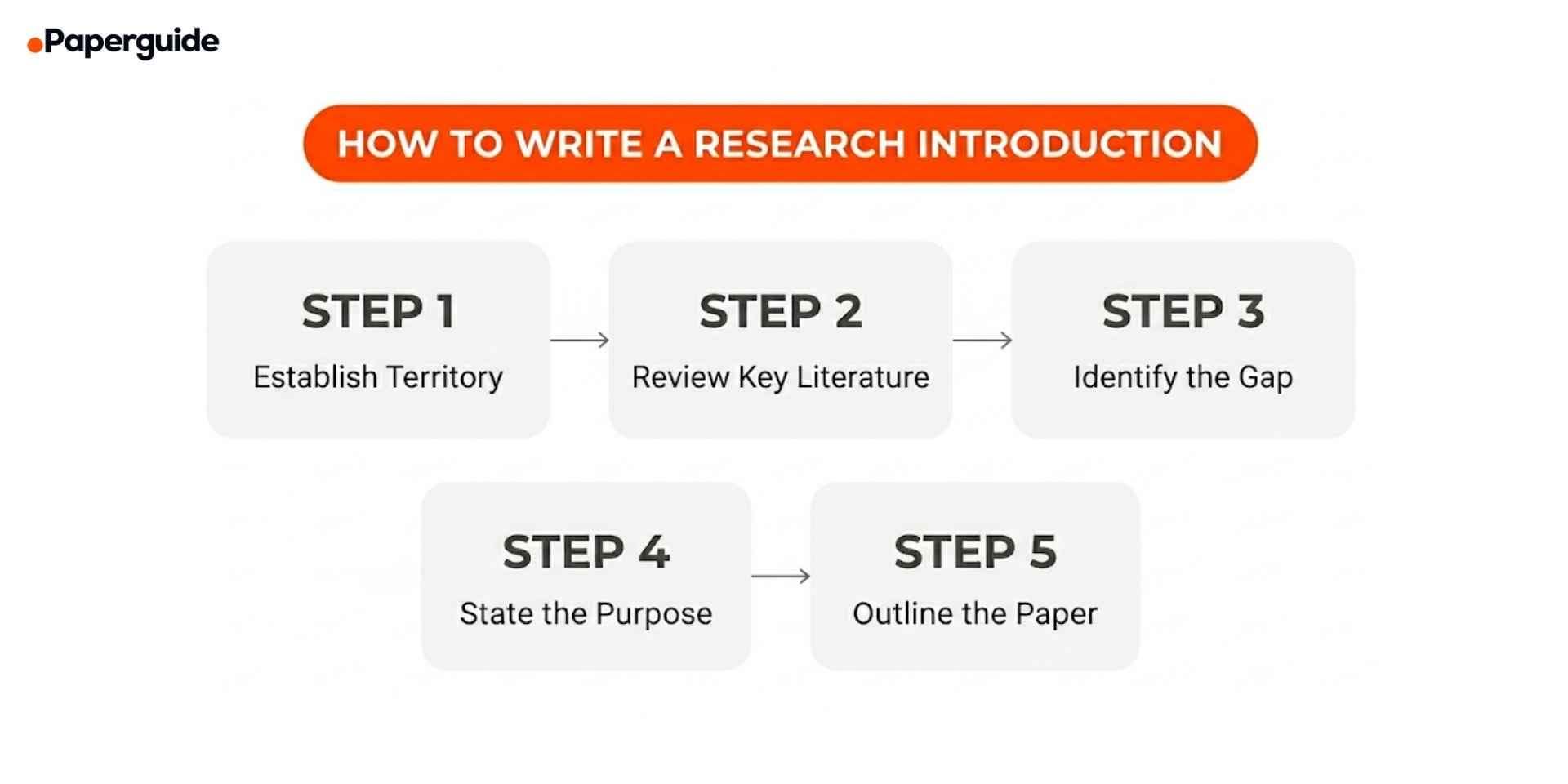
Step 1: Open by Establishing the Topic's Importance (Move 1)
Begin with a statement that demonstrates why the topic matters. This can be done by citing prevalence data, showing real-world impact, referencing a theoretical debate, or highlighting a practical problem. The opening should be direct and specific rather than vague or overly broad. [5]
Effective opening: "Antibiotic resistance is responsible for an estimated 1.27 million deaths annually worldwide (Murray et al., 2022), and the development of new antimicrobial agents has not kept pace with the emergence of resistant strains."
Ineffective opening: "Since the beginning of time, humans have battled disease." The first is specific and grounded in evidence. The second is vague and wastes the reader's attention.
Step 2: Review Key Literature Selectively (Move 1, continued)
After establishing importance, present the key studies that define the current state of knowledge on your specific topic. This is not a comprehensive literature review; it is a curated summary of the most relevant findings that the reader needs to understand in order to appreciate the gap. [2]
Organize literature thematically rather than chronologically. Each paragraph should make a point, supported by multiple citations, rather than describing one study at a time. Synthesis demonstrates that you understand the literature as a coherent body of evidence, and developing this skill through evidence synthesis projects transfers directly to stronger introduction writing.
Step 3: Identify the Gap or Problem (Move 2)
After presenting what is known, pivot to what is not known. This is the most critical sentence or paragraph in the introduction because it establishes the justification for your study. The gap can take several forms: a question that has not been investigated, a population that has not been studied, a methodology that has not been applied, conflicting evidence that needs resolution, or an outdated finding that needs updating. [1]
Use clear transition language: "However," "Despite these findings," "What remains unclear is," "No study has examined." The gap must be specific enough that the reader can verify it by examining the literature you have cited.
Step 4: State the Research Purpose or Hypothesis (Move 3)
Immediately after the gap, state your research purpose, question, or hypothesis. This should follow directly from the gap, creating a logical chain: "We know X and Y, but we do not know Z. Therefore, this study aims to examine Z".
The purpose statement should include the study design if space permits: "Using a randomized controlled trial design, this study evaluates..." or "Through semi-structured interviews with 30 participants, this research explores..." This gives the reader an immediate sense of the methodological approach without requiring them to skip ahead to the methods section.
Step 5: Provide a Brief Outline of the Paper (Optional, Move 3)
Some disciplines and journals expect a brief statement at the end of the introduction that outlines the paper's structure: "The remainder of this paper is organized as follows. Section 2 describes the methodology. Section 3 presents the results. Section 4 discusses the findings in relation to existing literature." This is more common in engineering, computer science, and some social science journals than in medical or humanities journals. [4]
If the journal convention does not include an outline, end the introduction with the purpose statement. The reader should be ready to move directly into the methods section.

Research Paper Introduction Examples
Example 1: Health Sciences (CARS Model Applied)
Move 1 (Territory): Chronic low back pain affects approximately 619 million people globally and is the leading cause of disability in 160 countries (GBD 2021 Low Back Pain Collaborators, 2023). Clinical guidelines recommend exercise therapy as a first-line treatment, and meta-analytic evidence supports moderate-to-large effects on pain and function compared to usual care (Hayden et al., 2021). Among exercise modalities, motor control exercises targeting trunk muscle activation patterns have received substantial research attention over the past two decades (Saragiotto et al., 2016).
Move 2 (Niche): However, the optimal dosage of motor control exercises remains unknown. Existing trials have used widely varying protocols (ranging from 8 to 24 sessions over 4 to 12 weeks), and no study has systematically compared different dosage levels within a single trial. Without dosage-response evidence, clinicians cannot make evidence-based decisions about treatment intensity, and some patients may be receiving subtherapeutic or unnecessarily prolonged treatment.
Move 3 (Occupation): This three-arm randomized controlled trial compares high-dose (24 sessions over 8 weeks), standard-dose (12 sessions over 8 weeks), and low-dose (6 sessions over 8 weeks) motor control exercise programs in adults with chronic low back pain, with pain intensity at 12 weeks as the primary outcome.
Example 2: Social Sciences (CARS Model Applied)
Move 1 (Territory): Employee voice, defined as the voluntary expression of ideas, suggestions, or concerns about work-related issues, is associated with improved organizational performance, innovation, and employee well-being (Morrison, 2011; Chamberlin et al., 2017). Research has identified multiple antecedents of employee voice, including psychological safety, leadership behavior, and perceived organizational support (Detert & Burris, 2007; Liang et al., 2012).
Move 2 (Niche): Despite this evidence, most voice research has been conducted in Western organizational settings, and the extent to which established antecedents generalize to hierarchical cultures with strong power distance norms is poorly understood (Botero & Van Dyne, 2009). In high power distance cultures, speaking up to supervisors may carry social costs that are qualitatively different from those in egalitarian settings, potentially altering the relationships between known antecedents and voice behavior.
Move 3 (Occupation): This study examines the relationships between psychological safety, supervisor openness, and promotive and prohibitive voice behaviors among 480 employees in South Korean manufacturing organizations. It tests whether power distance orientation moderates the effect of psychological safety on voice, contributing to cross-cultural voice theory and informing multinational organizations managing diverse workforces.
Research Paper Introduction Template
Paragraph 1 (Move 1 - Territory):
Paragraph 2 (Move 1 continued - Key Literature):
Paragraph 3 (Move 2 - Niche):
Paragraph 4 (Move 3 - Occupation):
Filled Example (Education):
Paragraph 1 (Move 1 - Territory):
Paragraph 2 (Move 1 continued):
Paragraph 3 (Move 2 - Niche):
Paragraph 4 (Move 3 - Occupation):
Common Mistakes When Writing a Research Introduction
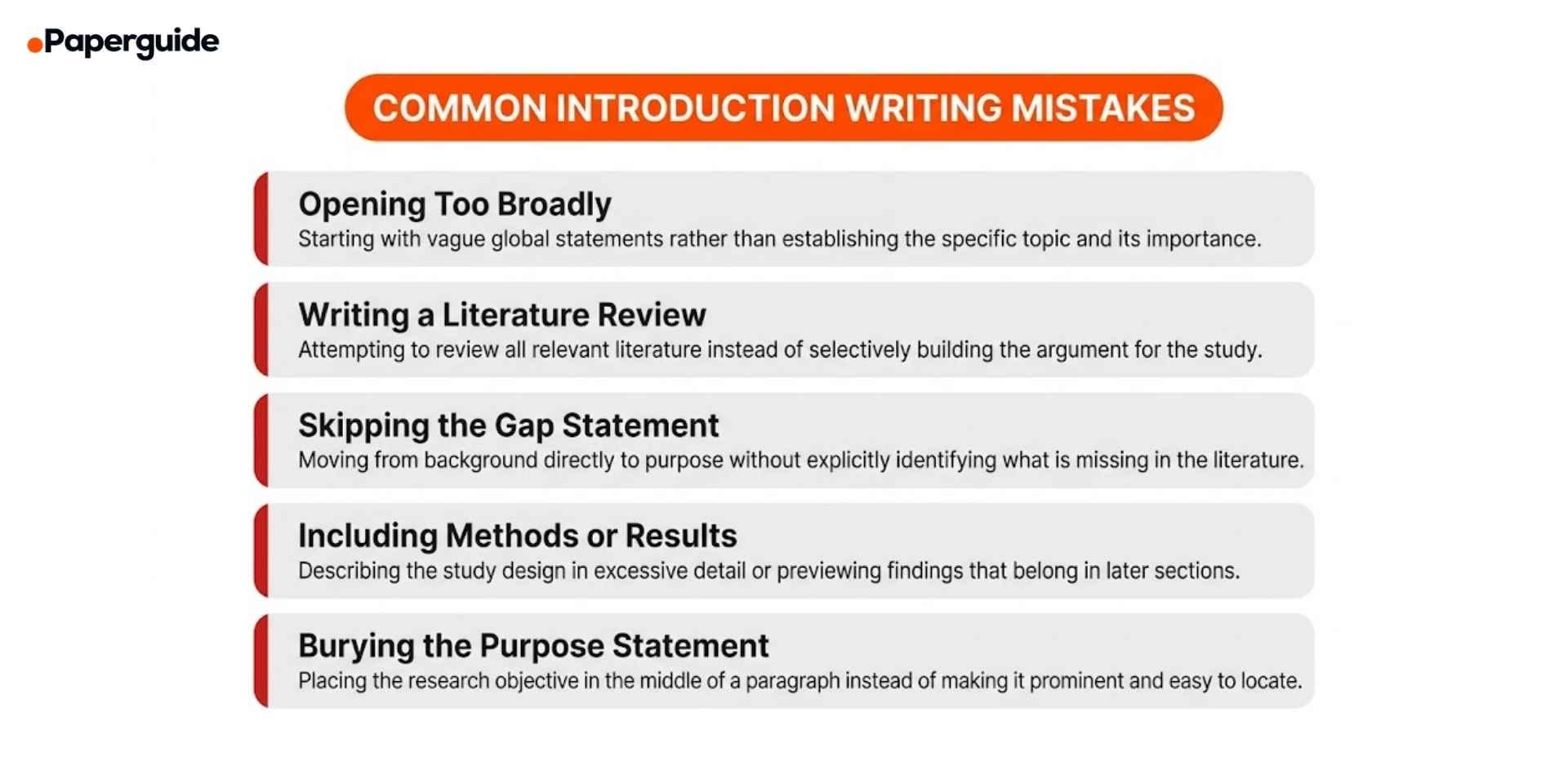
Opening too broadly. Introductions that begin with "Since the dawn of time" or "In today's rapidly changing world" waste the reader's attention on empty generalities. Start with the specific field or phenomenon your study addresses. The first sentence should orient the reader to the topic, not to the history of civilization. [5]
Turning the introduction into a literature review. The introduction should cite 15 to 25 references selectively to build the argument for the study. It should not attempt to cover every relevant study comprehensively. Save exhaustive coverage for the literature review chapter (in a thesis) or for the discussion section (in a journal article).
Omitting the gap statement. Without a clear gap, the introduction fails to justify the study. Every introduction must include at least one explicit sentence identifying what is not known, unresolved, or inadequately addressed. This is Move 2 in the CARS model, and skipping it is the most common structural flaw in introductions.
Including methods or results. The introduction should not describe the study design in detail or preview the findings. A brief mention of the approach ("using a randomized controlled trial design") is acceptable in the purpose statement, but detailed methods belong in the methods section. Including results in the introduction is almost never appropriate.
Burying the purpose statement. The research purpose should be clearly identifiable, ideally in the final paragraph of the introduction. Embedding it in the middle of a paragraph surrounded by other text makes it difficult for reviewers to locate. Use direct language: "This study aims to..." or "The purpose of this research is to...". [4]
Research Paper Introduction Checklist
- [ ] Topic importance established. The opening paragraph(s) demonstrate why the topic matters using evidence, data, or theoretical significance.
- [ ] Key literature synthesized. Relevant studies are cited selectively and organized thematically to build the argument for the study.
- [ ] Gap explicitly stated. At least one clear sentence identifies what remains unknown, contradictory, or underexplored.
- [ ] Purpose statement included. The introduction concludes with a specific statement of the study's aim, question, or hypothesis.
- [ ] CARS structure followed. The introduction moves logically from territory (Move 1) to niche (Move 2) to occupation (Move 3).
- [ ] No excessive background. The introduction is focused and selective, not an exhaustive literature review.
- [ ] No methods or results included. Detailed methodology and findings are reserved for their respective sections.
- [ ] Appropriate length. The introduction is proportional to the paper (typically 10 to 15 percent of total word count for journal articles).
- [ ] Smooth transitions. Each paragraph flows logically into the next, with clear transition signals between moves.
- [ ] Consistent with abstract. The introduction and abstract tell the same story and identify the same gap and purpose.
How to Adapt the Introduction for Different Paper Types
The CARS model applies to most research paper types, but the emphasis varies. For empirical papers (RCTs, surveys, experiments), the introduction should be concise and focused, with the gap stated in terms of missing evidence and the purpose stated as a testable hypothesis or research question. For qualitative papers, the introduction may place greater emphasis on the theoretical framework and the rationale for the chosen methodology. For systematic reviews, the introduction should establish the clinical or policy question, note the absence of an existing high-quality review, and state the review objective using a structured format such as PICO.
Validate This With Papers (2 Minutes)
Before submitting your manuscript, verify that your introduction meets the structural and scholarly standards expected by your target journal.
Step 1: Use Paperguide's Essay Topic Generator to explore related research angles and confirm that your gap statement targets a genuinely underexplored area rather than one already addressed by recent publications you may have missed.
Step 2: Read the introduction in isolation and check that it follows the CARS model: Move 1 (territory) before Move 2 (niche) before Move 3 (occupation). If any move is missing or out of order, restructure.
Step 3: Verify that the purpose statement at the end of the introduction matches the research question stated in the abstract and the objectives listed in the methods section. Inconsistencies between sections are a common cause of reviewer criticism.
This takes about two minutes and helps ensure your introduction is well-structured, well-sourced, and aligned with the rest of the manuscript.
Conclusion
The research paper introduction is the section that determines whether readers engage with your study or move on. By following the CARS model, you create a logical progression from what is known (territory), to what is missing (niche), to what your study will do about it (occupation). This three-move structure is the standard expectation across disciplines, and it works because it mirrors the natural reasoning process: understanding context, recognizing a problem, and proposing a solution.
The most effective introductions are selective rather than exhaustive, synthesizing literature to build an argument rather than listing studies to demonstrate breadth. They state the gap explicitly, connect it to the study purpose directly, and leave the reader with a clear understanding of what the research will contribute. Writing the introduction is easier when you have already drafted the discussion section, because the discussion reveals which aspects of the introduction need the most emphasis. Use the template, examples, and checklist in this guide to structure your introduction efficiently and present your study in its strongest possible light.
Frequently Asked Questions
How long should a research paper introduction be?
For a journal article, the introduction typically ranges from 500 to 1000 words, representing roughly 10 to 15 percent of the total manuscript. For a thesis or dissertation, the introduction chapter may be 2000 to 5000 words. Always check the target journal's guidelines, as some journals specify length limits for individual sections.
Should the introduction include the research hypothesis?
Yes, if the study tests a hypothesis. The hypothesis should appear at the end of the introduction, typically as part of the purpose statement (Move 3). For exploratory or qualitative studies that do not test hypotheses, state the research question or objective instead. The key is that the reader knows exactly what the study investigates before they reach the methods section.
Can I cite my own previous work in the introduction?
Yes, if your previous work is directly relevant to establishing the context, gap, or rationale. Self-citation should follow the same standards as citing any other source: include your work because it contributes to the argument, not to inflate your citation count. Excessive self-citation may be flagged by reviewers.
What is the difference between the introduction and the background?
In a journal article, the background is typically the first part of the introduction, establishing what is known before the gap is identified. In a thesis, the background may be a separate section or chapter. The introduction is the broader structural unit that encompasses the background, the gap, and the purpose statement. The background provides context; the introduction provides the full argument for the study.
Should I define key terms in the introduction?
Define terms that are essential for understanding the research question and that the reader may not know. If your study investigates "moral injury in healthcare workers," define moral injury in the introduction. If your study uses common disciplinary terms that your target audience will know, definitions are unnecessary and waste space.
How do I write an introduction for a review paper?
Follow the same CARS structure but adapt the content. Move 1 establishes the topic and its importance. Move 2 identifies the need for a review (no existing review, outdated review, or review covering a different scope). Move 3 states the review objective, typically using a structured format such as "This systematic review aims to synthesize evidence on..." Include the search scope and key databases if required by the journal.
What should I not include in the introduction?
Do not include detailed methodology (save for the methods section), specific results or data (save for the results section), extensive interpretation of findings (save for the discussion), or a comprehensive literature review that covers every study ever published on the topic. The introduction is selective and purpose-driven.
References
- Swales, J. M. "Genre Analysis: English in Academic and Research Settings." Cambridge University Press, 1990.
- Tavakol, M. & O'Brien, D. "The Importance of Crafting a Good Introduction to Scholarly Research: Strategies for Creating an Effective and Impactful Opening Statement." International Journal of Medical Education, 14(84), 84-87, 2023.
- Menon, V., Varadharajan, N., Praharaj, S. K. & Ameen, S. "Why Do Manuscripts Get Rejected? A Content Analysis of Rejection Reports from the Indian Journal of Psychological Medicine." Indian Journal of Psychological Medicine, 44(1), 59-65, 2022.
- American Psychological Association. "Publication Manual of the American Psychological Association." 7th edition, 2020.
- Cargill, M. & O'Connor, P. "Writing Scientific Research Articles: Strategy and Steps." 3rd edition, Wiley-Blackwell, 2021.


