
How to Write a Research Rationale: Definition, Examples & Justification


A research rationale is the section of a proposal, thesis, or manuscript that explains why the study is necessary and what contribution it will make to existing knowledge. It answers the question every reviewer and reader will ask: why does this study matter? The rationale connects the identified research gap to the purpose of the study, providing the logical justification for conducting the research rather than leaving the gap unaddressed. [1]
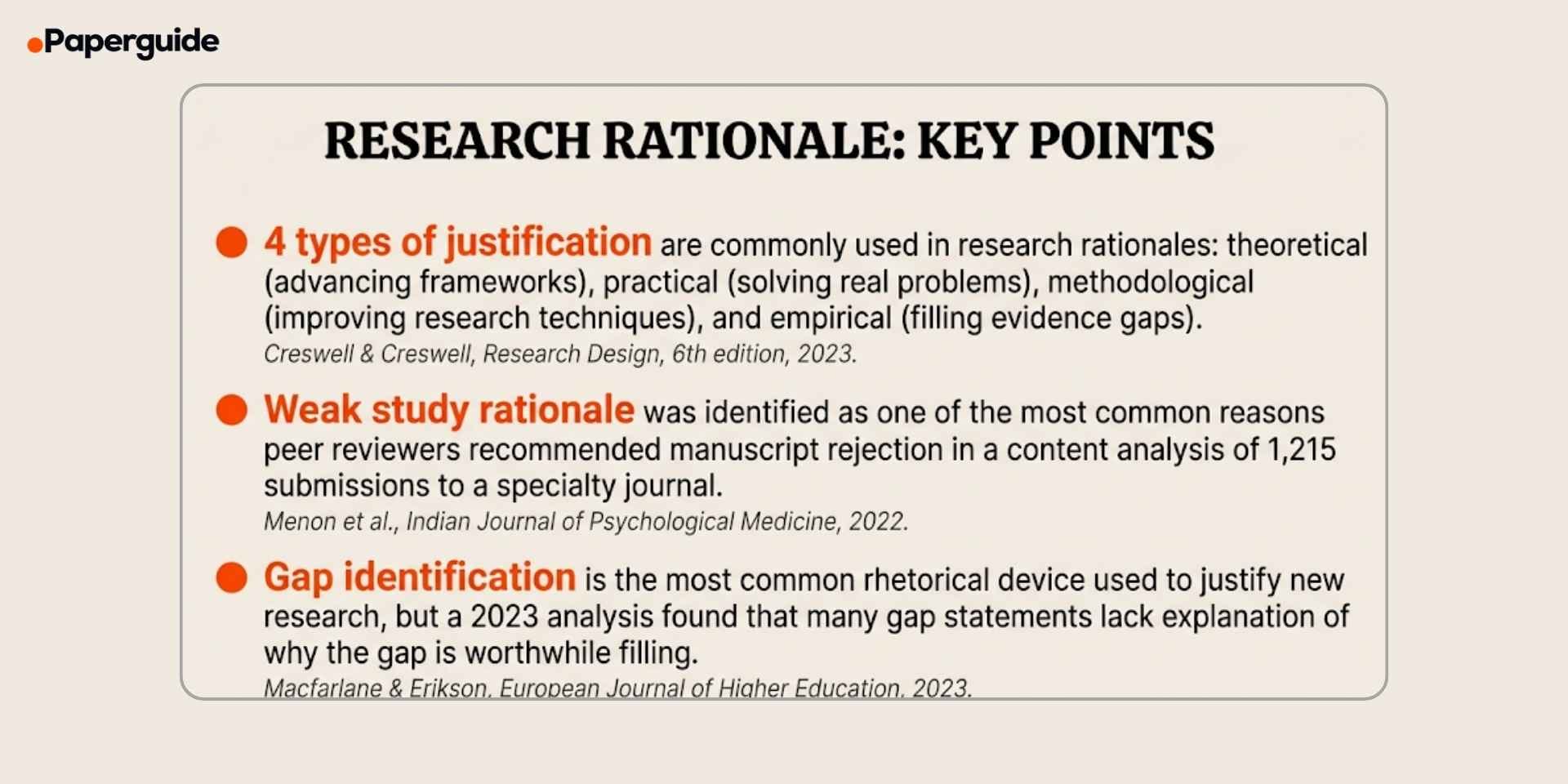
The rationale is often the deciding factor in whether a manuscript is accepted or rejected, a grant proposal is funded, or a thesis committee approves a research plan. Menon et al. (2022) analyzed 1,215 manuscripts submitted to a specialty journal and found that weak study rationale and poor justification were among the most common reasons for rejection. A vague rationale that states "this topic is important" or "more research is needed" does not meet the standard expected by academic gatekeepers. This guide explains what a research rationale is, distinguishes it from related concepts like the research background and significance, walks through the writing process with examples, and provides a template you can adapt to any discipline. [2]
Key Takeaways
- The research rationale explains why a study is needed by connecting the research gap to the study's purpose and expected contribution
- It differs from the background (which describes what is known) and the significance (which describes the broader impact of findings)
- Four common types of justification are used: theoretical, practical, methodological, and empirical
- An effective rationale is specific, evidence-based, and directly tied to the identified gap in the literature
- Weak rationales that rely on vague importance claims or personal interest statements are a common cause of manuscript rejection
What Is a Research Rationale?
The research rationale is the argument that justifies conducting a specific study. It appears most commonly in the introduction of a journal article, the opening chapter of a thesis or dissertation, or the significance section of a research proposal. The rationale explains why the study is worth doing by articulating what is missing from the current body of knowledge and why filling that gap matters. [1]
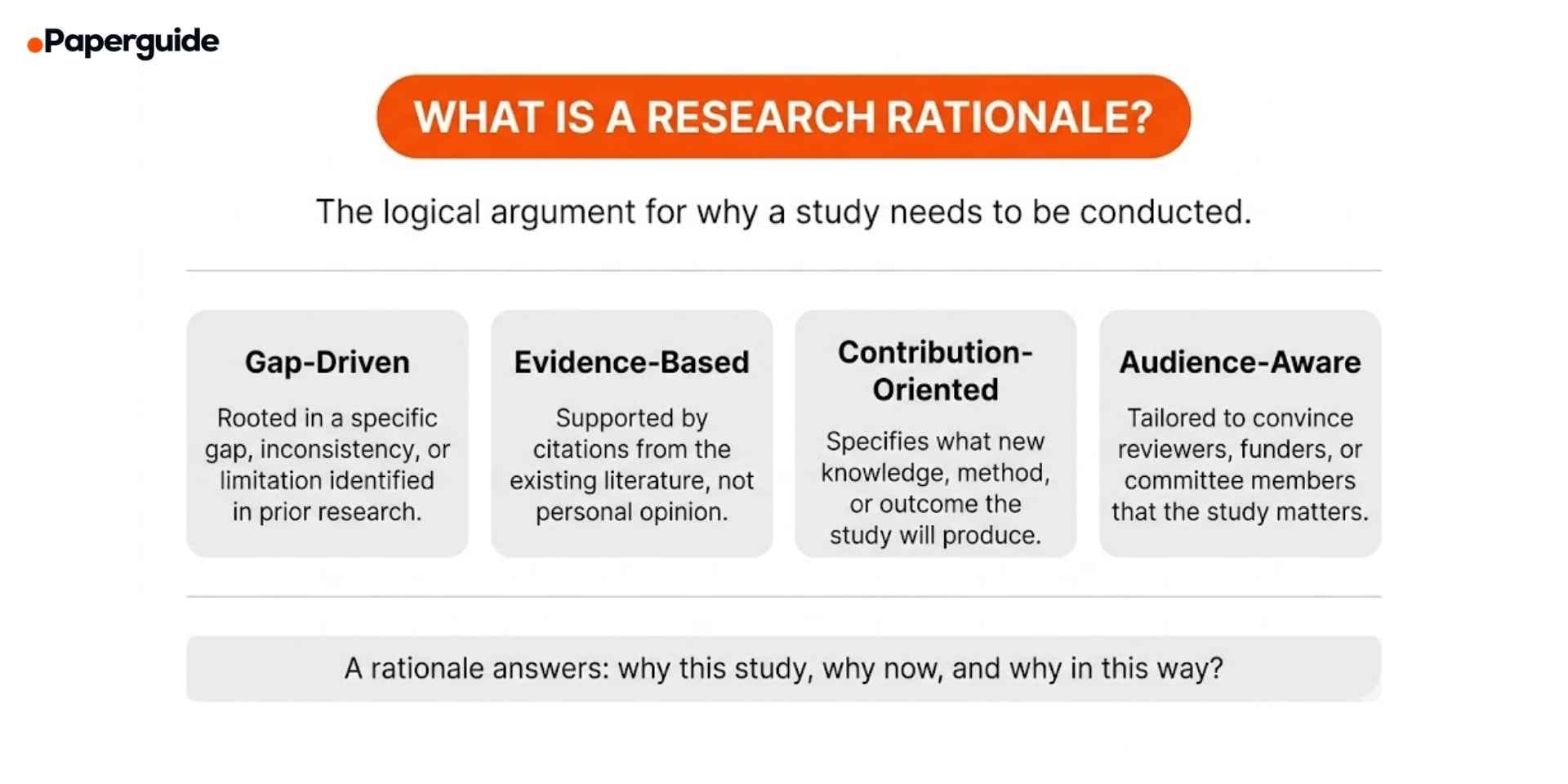
A rationale is not a description of your personal interest in the topic, and it is not a restatement of the research background. It is a focused argument built on three elements: the gap (what is missing), the justification (why it matters), and the contribution (what your study will add). Every effective rationale includes all three elements, and the strength of the rationale depends on how well each element is supported by evidence from the literature. [3]
The rationale typically appears after the background section has established context and identified the gap. Where the background tells the reader "here is what we know and here is what we do not know," the rationale tells the reader "here is why what we do not know is a problem and here is how this study will address it."
Rationale vs Background vs Significance
These three concepts are related but serve different functions in a research paper.
| Feature | Research Rationale | Background of the Study | Significance of the Study |
|---|---|---|---|
| Core question | Why is this study needed? | What is already known about the topic? | What impact will the findings have? |
| Focus | Justification for conducting the study | Existing literature and research context | Broader implications for theory, practice, or policy |
| Position in paper | After the gap statement, before the objectives | Opening section of the introduction or first chapter | After the rationale or in a dedicated section |
| Evidence type | Literature gaps, contradictions, limitations | Published research findings and established knowledge | Potential applications, affected populations, policy relevance |
| Typical length | 1 to 3 paragraphs | 2 to 5 paragraphs (articles), 3 to 10 pages (theses) | 1 to 2 paragraphs |
In practice, these sections often overlap. A journal article introduction may weave the background, rationale, and significance together within a few paragraphs. In a thesis or grant proposal, they are more likely to appear as separate, clearly labeled sections. [4]
Types of Research Justification
Research rationales draw on different types of justification depending on the nature of the study and the gap it addresses.
Theoretical justification. The study extends, tests, or challenges an existing theoretical framework. For example: "Social cognitive theory predicts that self-efficacy mediates the relationship between training and performance, but this prediction has not been tested in the context of remote work environments."
Practical justification. The study addresses a real-world problem that practitioners, policymakers, or communities need resolved. For example: "Hospital readmission rates for heart failure patients remain above 20 percent despite guideline-directed therapy, and clinicians need evidence on whether post-discharge telehealth monitoring can reduce these rates."
Methodological justification. The study introduces or tests a new research method, measurement tool, or analytical approach. For example: "Existing measures of workplace incivility rely on self-report, which is subject to recall bias. This study develops and validates an observational coding scheme."
Empirical justification. The study fills a specific evidence gap where data is missing or insufficient. For example: "No study has examined the prevalence of food insecurity among doctoral students in STEM programs, despite emerging evidence that financial stress affects this population disproportionately."
Most rationales combine two or more types of justification to create a stronger argument. [1] [3]
How to Write a Research Rationale
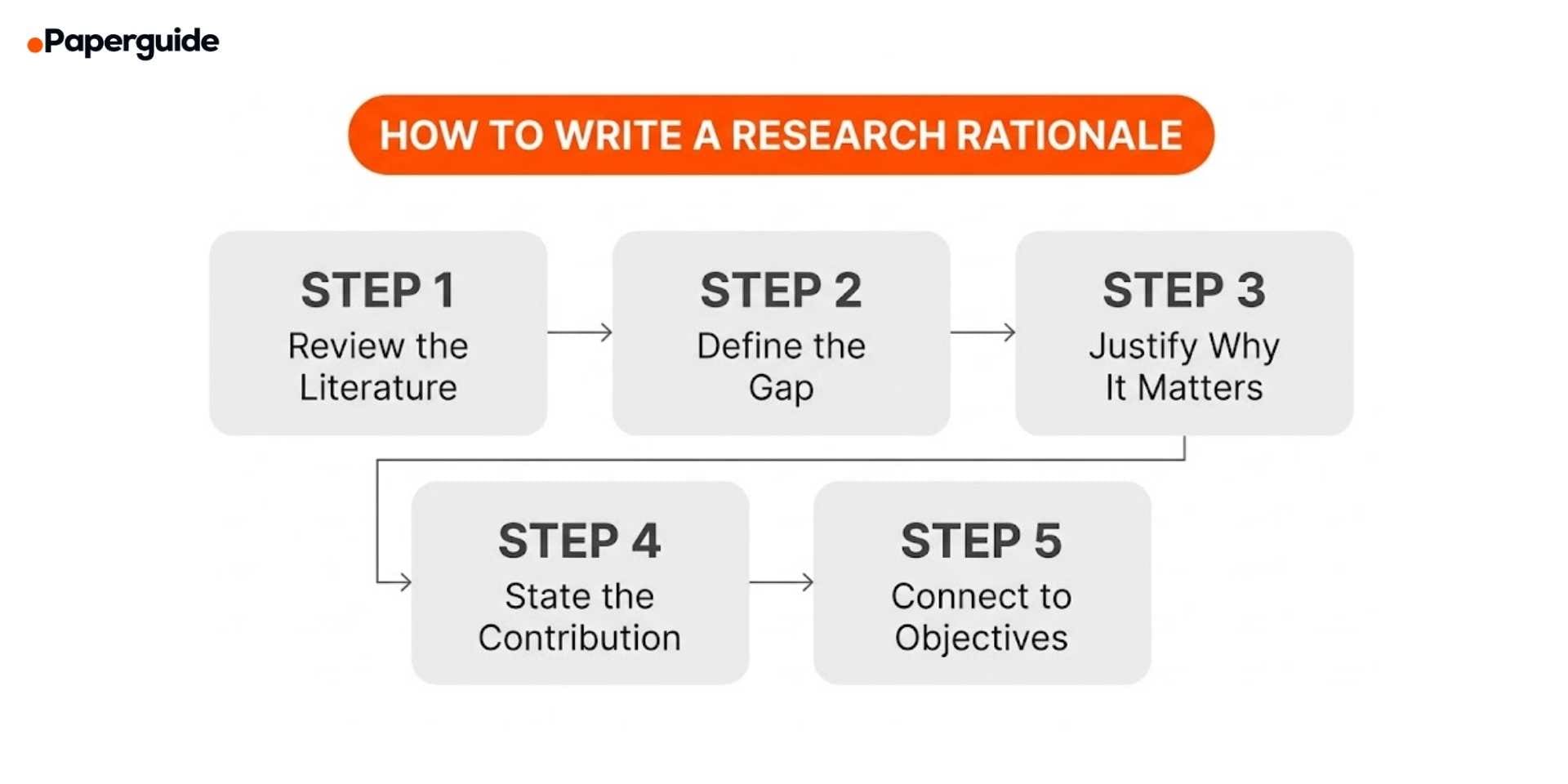
Step 1: Review the Literature Thoroughly
Before writing the rationale, you need a clear understanding of what has been studied, what methods have been used, and what findings have been reported. A thorough literature review reveals the patterns, contradictions, and limitations that will form the basis of your justification. Without this step, you risk writing a rationale based on assumptions rather than evidence. [3]
Focus your review on studies closely related to your research question. Pay particular attention to the discussion and limitations sections of recent papers, where authors often identify gaps that future research could address. Researchers conducting systematic reviews develop particularly strong skills in identifying gaps because the systematic review process explicitly maps what evidence exists and what is missing.
Step 2: Define the Gap Precisely
The gap must be specific enough that a reader can verify it by examining the literature. Vague statements like "limited research exists" or "this area is understudied" are insufficient. Instead, specify exactly what is missing: a population that has not been studied, a variable that has not been measured, a method that has not been applied, or a context in which existing findings have not been tested.
Strong gap statements name the specific absence: "No randomized controlled trial has tested cognitive behavioral therapy for insomnia in adolescents with autism spectrum disorder" is verifiable and specific. "More research is needed on sleep in neurodevelopmental populations" is vague and unconvincing.
Step 3: Justify Why the Gap Matters
Identifying a gap is not enough. You must explain why filling the gap is important. Ask yourself: what are the consequences of this gap for theory, practice, or policy? Who is affected by the lack of evidence? What decisions cannot be made well because this evidence is missing?
For example, if no study has evaluated a specific intervention in a specific population, explain why the population's characteristics make it inappropriate to generalize from existing evidence. If existing studies use a method with known limitations, explain what those limitations might have distorted and why a different method is needed. [5]
Step 4: State the Contribution Your Study Will Make
The contribution statement explains what your study will add to the field if it is completed successfully. Be specific about the type of contribution: new empirical evidence, a new theoretical insight, a validated measurement tool, or a practical recommendation supported by data.
Effective contribution statements use language such as "this study will provide the first empirical evidence on," "this research will test whether the established relationship between X and Y holds in the context of Z," or "the findings will inform clinical guidelines for". The contribution should be proportional to the study design; do not overclaim.
Step 5: Connect the Rationale to Your Research Objectives
The rationale should flow directly into the research objectives, questions, or hypotheses. The reader should be able to see a clear logical chain: the literature shows a gap, the gap has important consequences, and the study objectives are designed to address the gap and its consequences.
Use transitional phrases such as "therefore, this study aims to," "to address this gap, the present research," or "guided by this rationale, the following research questions are proposed". This connection closes the argumentative loop and positions the study as a necessary response to the problem you have identified. [4]

Research Rationale Examples
Example 1: Health Sciences
Medication non-adherence in patients with Type 2 diabetes is associated with increased hospitalization and healthcare costs (Cramer et al., 2008; Ho et al., 2009). Several interventions have been tested, including pharmacist-led counseling, mobile health reminders, and simplified dosing regimens (Nieuwlaat et al., 2014). However, most intervention studies have focused on patients in urban tertiary care settings, and the effectiveness of these approaches in rural primary care populations with limited pharmacy access is unknown.
This gap has practical consequences. Rural patients with Type 2 diabetes experience higher rates of complications and lower rates of glycemic control compared to urban patients (Lutfiyya et al., 2007), yet the interventions shown to improve adherence in urban settings may not be feasible or effective when pharmacy visits are infrequent and digital literacy is variable. This study will evaluate a community health worker-led adherence intervention designed specifically for rural primary care clinics, providing evidence to guide intervention adaptation for populations currently underserved by existing research.
Why this works: The rationale identifies a specific gap (no intervention tested in rural primary care), explains why it matters (rural patients have worse outcomes and different access constraints), and states the contribution (evidence for a tailored intervention).
Example 2: Social Sciences
Workplace mentoring programs are widely adopted in organizations to support employee development and retention (Allen et al., 2004; Eby et al., 2008). Meta-analytic evidence shows moderate positive effects on career outcomes and job satisfaction (Eby et al., 2013). However, nearly all mentoring research has been conducted in Western organizational cultures, and theoretical models of mentoring assume relational dynamics that may not hold in collectivist cultures where hierarchical relationships carry different social meanings (Ramaswami & Dreher, 2007).
This gap limits the generalizability of current mentoring theory and creates uncertainty for multinational organizations implementing mentoring programs across cultural contexts. The present study examines mentoring relationship quality and career outcomes among employees in Japanese manufacturing firms, testing whether Kram's (1985) mentoring functions model applies in a cultural context characterized by strong hierarchical norms and group-oriented work practices.
Why this works: The rationale uses both theoretical and empirical justification, names the specific theoretical model being tested, and identifies the practical implications for organizations.
Research Rationale Template
Use the following template to structure your rationale section.
Sentence 1 (Context):
Sentence 2 (Existing Evidence):
Sentence 3 (Gap):
Sentence 4 (Why It Matters):
Sentence 5 (Contribution):
Filled Example (Education):
Sentence 1 (Context):
Sentence 2 (Existing Evidence):
Sentence 3 (Gap):
Sentence 4 (Why It Matters):
Sentence 5 (Contribution):
Common Mistakes When Writing a Research Rationale
Using personal interest as justification. A rationale built on "I chose this topic because I am passionate about it" does not meet academic standards. Reviewers evaluate whether the study is needed by the field, not whether the researcher finds it interesting. Replace personal statements with evidence-based arguments grounded in the literature.
Writing vague gap statements. "There is limited research on this topic" is the weakest possible gap statement. Every gap must be specific: what population, variable, method, or context has not been studied? If you cannot name the specific absence, you have not reviewed the literature thoroughly enough.
Overclaiming the contribution. A single study cannot "fill the gap completely" or "resolve the debate." Use proportional language: "this study will provide initial evidence," "this research contributes to a growing body of work," or "the findings will extend current understanding." Overclaiming invites reviewer skepticism. [5]
Skipping the justification step. Many rationales identify a gap but fail to explain why it matters. The gap itself is not the rationale. The rationale is the argument for why the gap is a problem that needs to be addressed. Without this step, the reader may agree that the gap exists but still question whether the study is worth conducting.
Confusing the rationale with the background. The background tells the reader what is known. The rationale tells the reader why what is not known is a problem and what the study will do about it. Repeating background information in the rationale section wastes space and weakens the argument. Researchers who revisit the rationale when writing the discussion section after completing their study will find that a well-crafted rationale makes the discussion easier to write, which makes getting it right from the start even more important.
Research Rationale Checklist
- [ ] Gap clearly identified. The rationale includes a specific, verifiable statement about what is missing from the literature.
- [ ] Justification provided. The rationale explains why the gap matters for theory, practice, policy, or an affected population.
- [ ] Contribution stated. The rationale describes what new knowledge, method, or outcome the study will produce.
- [ ] Evidence-based argument. Every claim in the rationale is supported by citations from the existing literature.
- [ ] No personal interest statements. The rationale is grounded in scholarly reasoning, not personal motivation.
- [ ] Proportional claims. The stated contribution matches the scope and design of the study.
- [ ] Logical flow from background. The rationale follows naturally from the background section and the gap statement.
- [ ] Connected to objectives. The rationale transitions directly to the research questions, hypotheses, or objectives.
- [ ] Concise and focused. The rationale is no longer than necessary to make the argument convincingly.
- [ ] No background repetition. The rationale does not restate information already covered in the background section.
How to Strengthen a Weak Rationale
If your rationale feels weak, apply these three tests. First, the specificity test: can you name the exact population, variable, method, or context that has not been studied? If not, narrow your gap statement. Second, the consequence test: can you explain what happens because this evidence is missing? Who makes worse decisions, what theory remains untested, what practice lacks evidence? If you cannot articulate the consequence, your justification needs strengthening. Third, the proportion test: does your stated contribution match what your study can realistically deliver? If not, adjust your claims to align with your study design.
Researchers who have already written the background of their study can use it as a foundation for the rationale, extracting the gap statement and building the justification argument from the evidence already synthesized in the background section.
Validate This With Papers
Before finalizing your rationale, verify that the gap you have identified is genuine and that your justification is well-supported.
Step 1: Use Paperguide's Research Topic Generator to search for recent studies on your specific topic. If a study published in the last two years has already addressed the gap you identified, you will need to refine your rationale to account for this new evidence and explain what your study adds beyond what has already been done.
Step 2: Check that every citation in your rationale accurately represents the original source. Verify author names, publication years, and the specific claims you are attributing to each source.
Step 3: Read the rationale aloud and confirm that it answers three questions clearly: what is the gap, why does the gap matter, and what will your study contribute? If any of these answers are missing or unclear, revise before submitting.
This takes about two minutes and ensures your research rationale is genuine, current, and convincing.
Conclusion
The research rationale is the section that transforms your study from a topic of personal interest into a necessary contribution to the field. By identifying a specific gap in the literature, explaining why that gap has consequences for theory or practice, and stating clearly what your study will contribute, you build the argument that convinces reviewers, funders, and committee members that the research is worth doing. The most effective rationales combine multiple types of justification and support every claim with evidence from the existing literature.
Writing a strong rationale requires the same skills as writing a strong scoping review: the ability to map existing evidence, identify patterns and absences, and articulate what the evidence does and does not tell us. Use the template and checklist provided in this guide to structure your rationale, and apply the three tests (specificity, consequence, proportion) to evaluate its strength before submission. A clear, well-supported rationale sets the tone for the entire manuscript and signals to readers that the study was conducted with purpose and rigor.
Frequently Asked Questions
What is the difference between a research rationale and a research justification?
In most academic contexts, these terms are used interchangeably. Both refer to the argument for why a study is needed. Some disciplines use "rationale" more frequently (social sciences, education), while others prefer "justification" (health sciences, engineering). The core requirement is the same: explain the gap, why it matters, and what the study will contribute.
Where does the research rationale appear in a paper?
In a journal article, the rationale typically appears in the introduction, after the background has established context and identified the gap. In a thesis or dissertation, it may appear as a labeled section within the introduction chapter or as a standalone section. In a grant proposal, it is often part of the significance or background and significance section.
How long should a research rationale be?
A journal article rationale is typically one to three paragraphs. A thesis rationale may be one to three pages. The length should be proportional to the complexity of the gap and the justification required. A straightforward empirical gap needs less justification than a study that challenges an established theory.
Can I use the same rationale for my proposal and my final thesis?
Yes, but you will likely need to update it. The core gap and justification should remain the same, but new studies published between the proposal and the thesis completion may require you to add recent citations and refine your gap statement to reflect the most current evidence.
What if no gap exists in the literature?
If no clear gap exists, consider whether your study offers a replication in a new context, a methodological improvement, or a test of existing findings under different conditions. These are all valid justifications. A rationale does not always require a gap; it can also be based on the need for confirmation, extension, or methodological refinement.
How do I write a rationale for qualitative research?
Qualitative research rationales often emphasize the need to understand experiences, perspectives, or processes that quantitative methods cannot capture. Instead of citing missing statistical evidence, you might argue that existing research has not explored the lived experiences of a specific group, the meaning participants attach to a phenomenon, or the processes underlying an observed pattern.
Should the rationale include the research question?
The rationale should lead directly to the research question but typically does not include it. The rationale builds the argument for why the study is needed, and the research question immediately follows as the logical response to that argument. Placing the research question within the rationale itself can blur the boundary between justification and study design.
References
- Creswell, J. W. & Creswell, J. D. "Research Design: Qualitative, Quantitative, and Mixed Methods Approaches." 6th edition, Sage Publications, 2023.
- Menon, V. et al. "Why Do Manuscripts Get Rejected? A Content Analysis of Rejection Reports from the Indian Journal of Psychological Medicine." Indian Journal of Psychological Medicine, 44(1), 59-65, 2022.
- Kumar, R. "Research Methodology: A Step-by-Step Guide for Beginners." 5th edition, Sage Publications, 2019.
- American Psychological Association. "Publication Manual of the American Psychological Association." 7th edition, 2020.
- Macfarlane, B. & Erikson, M. G. "The Gap Statement and Justification in Higher Education Research: An Analysis of Published Articles." European Journal of Higher Education, 14(2), 459-475, 2023.


